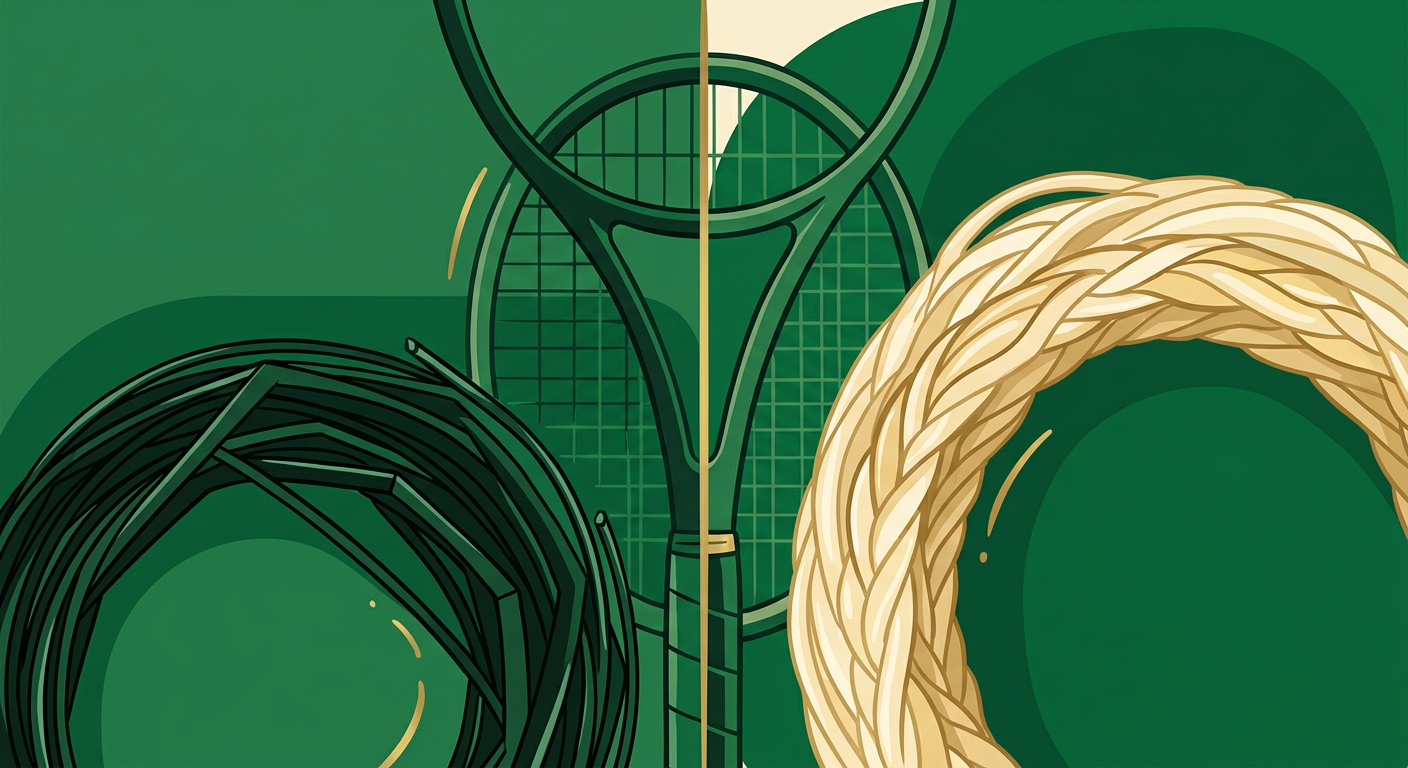

Polyester and multifilament are the two main string types that most intermediate and advanced players choose between. They feel completely different on court, suit different playing styles and wear out in different ways.
The short version: polyester gives you control and spin, multifilament gives you comfort and power. Most players lean strongly towards one or the other based on how they play.
This guide breaks down every meaningful difference so you can make the right choice. If you want a full overview of all string types including synthetic gut, read our complete guide to choosing tennis strings.
Quick Comparison
| Feature | Polyester | Multifilament |
|---|---|---|
| Control | ★★★★★ | ★★★ |
| Spin | ★★★★★ | ★★★ |
| Power | ★★ | ★★★★★ |
| Comfort | ★★ | ★★★★★ |
| Durability | ★★★★★ | ★★★ |
| Arm-friendliness | ★★ | ★★★★★ |
| Tension maintenance | ★★★ | ★★★★ |
| Best for | Fast swings, spin, control | Comfort, power, arm concerns |
What Is Polyester String?
Polyester (also called co-polyester or co-poly) is a single solid filament of polyester material. It is firm, durable and gives a controlled, predictable response — especially on bigger swings.
Polyester is the dominant string on the professional tour and the most popular choice among club players who hit with topspin. It comes in several sub-types:
- Round co-poly: Smooth, predictable control. Examples: Babolat RPM Blast, Luxilon ALU Power.
- Shaped co-poly: Angular edges that grip the ball for extra spin. Examples: Solinco Hyper-G, Head Lynx Tour.
- Textured co-poly: Rough surface for maximum bite. Example: Babolat RPM Blast Rough.
- Soft co-poly: Softer feel while keeping poly control. Example: Luxilon Element.
Polyester Strengths
- Spin: The firm string bed snaps back quickly, generating topspin on groundstrokes. Shaped and textured polys add even more bite.
- Control: Polyester does not launch the ball as far, making it easier to keep the ball in the court on fast swings.
- Durability: Poly lasts longer than multifilament for players who break strings regularly.
- Consistency: The response is predictable and stable, especially for flat-to-topspin baseliners.
Polyester Weaknesses
- Comfort: Poly is stiffer than multifilament. Strung too high or left in the racket too long, it can feel harsh and unforgiving.
- Power: You need to generate your own power. Poly does not help the ball leave the string bed with easy depth.
- Dead feel over time: Polyester loses its lively response before it breaks. Many players describe “dead poly” as stiff, boardy and unresponsive. This matters for how often you should restring.
- Arm stress: The stiffness can contribute to arm discomfort in some players, especially at higher tensions.
What Is Multifilament String?
Multifilament strings are made from hundreds or thousands of thin fibres braided together. The construction is designed to mimic natural gut — the gold standard for comfort and feel.
The result is a string that is softer, more powerful and more arm-friendly than polyester.
Multifilament Strengths
- Comfort: The multi-fibre construction absorbs shock, making the racket feel plush and forgiving.
- Power: Multifilament strings trampoline the ball off the string bed with easier depth, even with shorter or slower swings.
- Arm-friendliness: The best choice for players with arm, elbow or wrist concerns.
- Touch and feel: Many players prefer multi for volleys, drop shots and net play because of the connected, lively feel.
Multifilament Weaknesses
- Durability: Multi frays and wears faster than polyester, especially for players who hit with heavy spin.
- Less spin: The softer string bed does not snap back as aggressively, giving less spin potential compared to shaped or textured polys.
- Less control on big swings: If you swing very fast, the extra power from multi can make the ball fly long. Poly’s lower launch may suit you better.
Head-to-Head: When to Choose Each
Choose Polyester If You:
- Swing fast and hit with topspin
- Want more control and spin from the baseline
- Break strings regularly
- Are an intermediate or advanced player
- Already have enough power in your swing
- Play matches and want a predictable, stable setup
PT Tennis polyester recommendations: Solinco Hyper-G (spin/control), Babolat RPM Blast (classic topspin), Luxilon ALU Power (match-day control), Yonex Poly Tour Fire (value performance). See all options on our prices page.
Choose Multifilament If You:
- Want more comfort and a softer feel
- Have arm, elbow or wrist concerns
- Want easier power without swinging harder
- Play with a mix of shots including volleys and touch
- Are a recreational or social player
- Prefer feel over raw spin
PT Tennis multifilament recommendation: Wilson Sensation Plus — soft, arm-friendly, easy depth. Available as a Tier 3 string at £25.
The Hybrid Option: Best of Both?
If you want polyester control in one direction and multifilament comfort in the other, a hybrid setup is worth considering.
How it works: Polyester in the mains (vertical strings) for control and spin, multifilament in the crosses (horizontal strings) for comfort and feel.
Is it worth it? For most recreational players, a single string keeps things simple. But if full poly feels too stiff and full multi gives you too little control, a hybrid can hit the sweet spot. We cover this in detail in our hybrid stringing guide.
Note: Hybrid setups use two different strings and may cost more. Ask us about pricing.
Tension Differences
Polyester and multifilament respond differently to tension. Getting this right matters as much as the string choice itself.
- Polyester: String lower, typically 46–52 lbs. Poly is already firm, so lower tension keeps it comfortable and playable. Stringing poly too high is a common mistake that makes the racket feel dead and harsh.
- Multifilament: Can handle a slightly higher tension, typically 50–57 lbs. The softer construction absorbs enough shock to stay comfortable even at higher tensions.
For specific tension recommendations, use our string and tension calculator or read the full tennis string tension guide.
Durability Comparison
| Factor | Polyester | Multifilament |
|---|---|---|
| Typical lifespan | 10–30 hours of play | 10–20 hours of play |
| How it wears | Goes dead before breaking | Frays before breaking |
| When to replace | When it loses feel | When fraying is visible |
| String breakers | Lasts well | Breaks faster |
The important difference: polyester’s biggest risk is not breaking — it is going dead. A racket with dead poly strings can feel harsh and unresponsive while the strings still look intact. This is why knowing when to restring matters more with poly.
Multifilament shows its wear more visibly. You can usually see fraying before it breaks, which gives you a clearer signal that it is time to restring.
Cost Comparison at PT Tennis
| Setup | Price |
|---|---|
| Own polyester string (labour only) | £20 |
| Tier 2 polyester (e.g. Yonex Poly Tour Fire) | £30 |
| Tier 1 polyester (e.g. Luxilon ALU Power) | £40 |
| Tier 3 multifilament (Wilson Sensation Plus) | £25 |
| Own multifilament string (labour only) | £20 |
Full pricing details: tennis stringing prices.
Which Strings Do Most Players Choose?
At PT Tennis, the majority of players choose polyester — specifically shaped and textured polys for spin. The most popular choices are Solinco Hyper-G, Babolat RPM Blast and Babolat RPM Blast Rough.
Players who choose multifilament tend to be recreational players, older players, or players recovering from arm injuries. Wilson Sensation Plus is the most popular comfort option.
A growing number of players are trying soft co-polyesters like Luxilon Element as a middle ground — softer than standard poly but with more control than multifilament.
Still Not Sure?
Tell us your racket, playing level and what you want from the racket. We will recommend a string and tension that suits your game.
- Use the string calculator to get an instant recommendation
- Message us on WhatsApp for personal advice
- View stringing prices to compare costs
- Book a drop-off when you are ready
Drop-off at Distillery Building, 11 Hart Yard, E3 2AL — convenient for Bow, Mile End, Victoria Park, Hackney, Stratford and Canary Wharf.